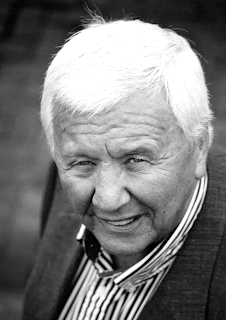
The weather recently has caused all the headlines with much harking back to previous winters with lots of a snow.
The years that are most invoked as the worse in living memory are 1947 and 1962/63, I remember them both.
In the winter of 1947 I was aged 14, in my last year at school. Rationing was in full swing, indeed I believe some things such as meat were in shorter supply than they had been during the war which hadn’t been over long. We, that's me, my Mum and Dad, brother Kenny and little sister Doreen lived in a little terraced house in Lamprell street, Old Ford, Bow, E.3. not far from Victoria Park. Another brother, Michael was yet unborn, he made his appearance in 1948.
They were tiny little dwellings, a little yard out the back with a toilet and a, as yet, undismantled Anderson shelter, my parents grew a few tomatoes and kept some hens and a cockerel. We had plenty of eggs even in the war, I remember my Mum making the fowls food with potato peelings and something called Karswoods, we hated the smell. When neighbours were ill my Mum would always give them some new laid eggs. The cockerel would generally disappear at Christmas, not for our table, my Dad would generally swop it with someone else’s, we couldn’t eat our own.
Me and Kenny slept in the same bed in a little room overlooking the yard, it was called the off-room, as I never saw it written down I always assumed it was called the Orphroom. There was no room for a fireplace, just room for our bed.
The other rooms had fireplaces in them, little tiny grates, they were never lit as coal wasn’t that easy to get. Our coal merchant was called Speller. My Mum liked him, he seemed kind and venerable with a white moustache and he seemed quite old but he must have been strong, him and his assistant would carry bag after bag of hundredweight's of coal on their backs into countless households. They would be pulled off a cart led by a faithful old horse that looked as venerable as Mr Speller himself.
The room we used as a living room was called the kitchen. It had a cooking range that was kept black-leaded by my Mum. The fire incorporated in the range was miniscule, it threw out very little heat and we boiled our kettles and did the cooking in the scullery an adjoining room with a boiler with a little fireplace in it to heat the water, a cold water sink with and a gas stove. So primitive but none of us had seen any better so we were happy enough. There was a tin bath hanging in the yard where the toilet was.
Even in a normal winter it was pretty cold in these households. I remember my Dad would get a flat iron and warm it on the hob and then go and iron our cold sheets before we got into bed. Hot water bottles were pre war luxuries, everything was short in those years including rubber. So in 1947 a labour government was trying to overcome the most horrendous shortages, Sir Stafford Cripps, the labour chancellor telling everyone that they would have to tighten their belts even further, the Coal fields in the midst of Nationalisation with Manny Shinwell the Minister of Fuel being determined that the mines would be the hub of our industry and then all this snow fell and divided the country into half. No lorries or trains could get through to the South with precious coal supplies, the National Grid not fully operational, and everyone told they could only use their electric fires three hours in the morning and three hours in the afternoon. That was all right if you had electric fires, we depended on coal and wood for our fires and plenty of blankets at night.
Even clothes we had to make do as best we could. I had an overcoat and Russian boots, as we called wellingtons, and a pair of mittens and what I thought of as a pilots helmet made of leather with ear muffs. I used to go to a yard somewhere near Roman road with Doreen's pram and fill it with Tarry logs. These were wooden bricks that had been used for roads and tarred over they made the most marvellous fuel.
What with lack of food, warmth, clothing how did we survive? From what I remember quite happily. We played snowballs and lots of games in the street and most people seemed very happy to me, grateful that the war was over and the future seemingly bright. How the grown ups felt I’m not sure but I don’t remember them grumbling much.
I also remember 1962/3. In October 1962 I took the ‘Two Puddings’ Pub. It was my first venture into business. It was a busy place a music house weekends and lots of food at lunchtimes. It was a big old place with a fire in both bars that I kept lit in winter, both fires attracted the customers who would hog them sitting or standing round them in cold weather, we had central heating of a kind that had been old in the thirties but it was inefficient, George my old Pot man would light it in the morning and pile it with coke, he was the only one who understood it and if he had a day off no one else could master it. Christmas 1962 it started to snow and never stopped till March 1963 and that was such a miserable time for me. The plumbing, the central heating, and the electric's were all ancient and needed redoing and that year I had eighteen burst pipes, flooding the pub and the next door shop completely one unforgettable day. The brewery would send me their builders to help and me and my wife and staff would spend days clearing up, that was in the days, fortunately, when the brewers would help you as much as they could at a drop of a hat and never charged anything for it.
Somehow, despite losing my cleaners who gave up in despair, that winter passed and even during that time not many people moaned, I even got better cleaners who delighted in getting stuck in, it did seem a cheerier more together world then, perhaps this recent reminder of what a winter should be like will make us all a little bit more understanding of hardships suffered in other places. I must say that in this world living with warm houses, too warm sometimes, warm cars, warm trains, warm shops we don’t ever get really cold, although I’m old now and would probably die of hypothermia I feel a little nostalgia for the days when getting inside in front of warm fire was a real luxury after being out in the cold all day.
Monday, 11 January 2010

Monday, 31 August 2009
SPIRIT OF THE ANDES

Behind a heavily beamed, rather crooked, wonderful old farmhouse known as the ‘Old Cottage’ at the bottom of Bull lane, Long Melford, there’s around 70 acres of lovely Suffolk countryside where Paul Rylott and his very pretty wife Judy started their Alpaca farm. The house was built in 1420 AD and when Paul first saw it and decided to buy, it looked disquietingly familiar. At first he thought it had appeared in his dreams as it fitted all the criteria he and Judy were looking for but he suddenly realised that when he was a tiny boy, living on a Lincolnshire farm, his Grandmother had a calendar that he much admired and the picture on it was of this house. ‘It was fate’ he told me, ‘I had to have this place’.
I’d called in to see Paul to ask if he’d put an advert in ‘Upbeat’ magazine, I’d interrupted his lunch but he said it didn’t matter and he invited me in for tea, I knew the farm had ‘open days’ and it occurred to me that perhaps our members would be interested in a tour, Paul said he’d be only too happy to show us round.
So it was that on the afternoon of Thursday the 13th of August a party of 13 ‘Upbeat’ members, gathered at the farm gate. The sun was shining, it was warm but a slight breeze tempered the heat making it an ideal English summers’ day.
First we went to the lean-to by the side of the house, a film screen was rigged up, comfortable chairs arranged and tables laden with cakes and home made biscuits, Judy, Paul's wife and business partner and Victoria, the young lady who helps them, served us with tea, it was all quite delicious five star treatment.
While we had tea Paul told us how he’d been head in the UK of a huge multinational corporation who had decided to close their operation in this country thus making him redundant. He was, of course, quite upset and not a little worried, his rosy future, all planned out till retirement, was in disarray. What to do? A great friend of his advised him not to be hasty “go away, do something you always wanted to do, forget about everything, go away and comeback with a clear head”. So he and Judy went to Peru, a place he always wanted to visit. They had a wonderful and exciting time, catching little trains that took them far up into the Andes. They both marvelled at the stunning scenery, the dramatic changes in climate, the friendliness and hospitality of the people and the animals, primarily the Alpaca but also the Llamas and the Vicuna, all members of the South American camelid family.
The Vicuna has the most valuable fleece, it is a rare animal only found at the highest altitudes of the Andes, to give an example of the value of it’s wool a Vicuna overcoat from Saville row would cost £50,000. As Paul said what would you buy instead of a Porsche? Alpacas whose wool is also soft are on the lower slopes and they congregate in herds of thousands but even they vary, Huacaya have a dense, spongy fleece that covers the body but the rarer Suri has lanky, silky long fibre coat that hangs in curly locks that is much sought after. Llamas, perhaps the best known of the camelids are a bit bigger and are more domesticated and used as pack animals in much of that region of South America.
When they came back from Peru, Paul's head was clear. Absolutely clear of any thoughts at all, he explained, and his money was running out.
Eventually after lots of agonising he and Judy bought the farm with the land and imported three of the finest Alpacas’ they could source, he was determined to be known for the quality of his animals. After being quarantined in Switzerland for 6 months they were allowed to come to Long Melford. That was 5 years ago, they now have one hundred and twenty and are known as one of the finest and most reliable breeders in the UK, hoping to export all over the world to places as diverse as Qatar, Germany, Russia and Portugal. The wool is also sold and is quite valuable, the best shearers in the world are New Zealanders and every year they come to the farm to shear the animals. Paul related all this and much more during his witty and well informed lecture which we all thoroughly enjoyed.
We were each given a little pot of food before strolling round the fields. To the nursery first where all the cute little babies, known as Cria, were kept, we were told not to feed them as they were rather shy at that early age, Victoria, or Vicky, the main help, knew all the Alpacas’ by their names, all the ladies are named after ‘Bond’ girls, there’s even a Miss Moneypenny and the main prize stud is named Sean, Vicky even knows the hens and cockerels who tear round the ground and they all recognise her. After the babies we saw the adolescents, a more frisky bunch. Then the older ones who needed no enticing. The colours of these charming animals range from black, blue-grey, grey, brown, mottled, cream to white.
As well as being great pets that can be trained for the lead they are also useful as fox deterrents, they protect the hens from the marauding foxes and have even been known to kill them.
To reach the older ones we had to pass over a little bridge that spanned the River Chad, apparently the Chad has more native freshwater crayfish than any other river. We never spotted any but I’m sure they were there lurking in the depths somewhere.
After our tour, during which many photos’ were taken it was back to the start for more tea and cake. Our visit finished about 4.30 but we all enjoyed the idyllic setting and the free and easy friendly manner in which Paul, Judy and Vicky welcomed us and though none of us bought any Alpacas I’m sure we all came away having high regard for the way in which the farm is run and with a lot of respect for Paul and his team.
Saturday, 8 August 2009
Guided Tour of Long Melford.
There was eighteen of us gathered at the ‘Bull’ Long Melford in the early evening of Thursday May 21st. All day the sun had been shining, now black clouds gathered and the rain came down in buckets.
We stood in the lee of the trees and the old Inn for shelter, some of us had macs’ and umbrellas’ but the clouds, almost as quick as they had arrived, lifted and our guide the eminent historian Barry Wall could start the tour.
He began by giving us a brief history of the ‘Bull’ itself, a building that goes back to the 15th century, but in Georgian times, as was the fashion, had a Georgian facade, this was so until the early 1960’s when Trust House Forte the then, sadly missed, owners took down the facade and restored the original features you see today, they also, very skilfully built an extension from the right-hand of the main door, encompassing the grand dining room, it needs a close inspection to realise this.
Barry explained the reason he loved Long Melford was because it had altered so much less than many other villages in the area such as Lavenham which, although very pretty and attractive, has not the integrity of Melford. Too many people over the years have imposed the, current at the time, values on so many of the old buildings in Suffolk so it’s rare to get a true picture, but Melford is better than most.
He told us to always look at the upper stories of a building, sometimes you see it with new eyes.
He told us about the two great houses of the area, Melford Hall and Kentwell Hall and about the Kings and Queens who’d graced the area when they turned up with a full retinue of servants and retainers like today’s 'celebs' who have teams of bodyguards, he explained that on this walk he wouldn’t take us to any of these places as Hall street itself would take at least two hours and we poor old codgers, game as we are, might not have enough puff.
Up the street we walked and Barry pointed out various gems like the house that a man wanted to maintain but couldn’t get the right bricks so he turned all the bricks round so they looked new...what a task!
And the working mans club where they had last read the ‘riot’ act in Britain. Strikers had marched from Glemsford and smashed lots of the buildings for the right to vote, the law was eventually altered so they got what they wanted.
The gem of the evening was ‘Cutlers’ Chapel, which is on the farm owned by the Cutlers and Mr & Mrs Cutler very kindly allowed us entrance to see. Some of the wood carvings in the chapel are among the finest in the world. One of our party, John Deeks commented how, as a lad,he’d worked on the farm during the war and said he had to milk a Guernsey cow for the family’s special supply of milk. He also told Mr Cutler how he remembered him being a pilot in the war and the gentleman told us how he’d flown home for a spot of leave and as he was piloting his aircraft to a nearby landing field he’d been amazed to see a Squadron of American bombers flying towards him. He had been training abroad so had no idea they’d been stationed in the vicinity.
We made our way back to the ‘Bull’ on the other side of the road this time. We had started at 6pm and got to the Bull at 8.15. Most of us went into the old Inn to have a beer and rest our feet, Barry had a pint with us and told us a few entertaining stories which wound the evening down nicely.
One very sad note David Espiner who’d been mainly responsible for organising the walk and was so looking forward to it was unable to come as he was in hospital and has since died. A lovely man who will be very missed at Upbeat.
We stood in the lee of the trees and the old Inn for shelter, some of us had macs’ and umbrellas’ but the clouds, almost as quick as they had arrived, lifted and our guide the eminent historian Barry Wall could start the tour.
He began by giving us a brief history of the ‘Bull’ itself, a building that goes back to the 15th century, but in Georgian times, as was the fashion, had a Georgian facade, this was so until the early 1960’s when Trust House Forte the then, sadly missed, owners took down the facade and restored the original features you see today, they also, very skilfully built an extension from the right-hand of the main door, encompassing the grand dining room, it needs a close inspection to realise this.
Barry explained the reason he loved Long Melford was because it had altered so much less than many other villages in the area such as Lavenham which, although very pretty and attractive, has not the integrity of Melford. Too many people over the years have imposed the, current at the time, values on so many of the old buildings in Suffolk so it’s rare to get a true picture, but Melford is better than most.
He told us to always look at the upper stories of a building, sometimes you see it with new eyes.
He told us about the two great houses of the area, Melford Hall and Kentwell Hall and about the Kings and Queens who’d graced the area when they turned up with a full retinue of servants and retainers like today’s 'celebs' who have teams of bodyguards, he explained that on this walk he wouldn’t take us to any of these places as Hall street itself would take at least two hours and we poor old codgers, game as we are, might not have enough puff.
Up the street we walked and Barry pointed out various gems like the house that a man wanted to maintain but couldn’t get the right bricks so he turned all the bricks round so they looked new...what a task!
And the working mans club where they had last read the ‘riot’ act in Britain. Strikers had marched from Glemsford and smashed lots of the buildings for the right to vote, the law was eventually altered so they got what they wanted.
The gem of the evening was ‘Cutlers’ Chapel, which is on the farm owned by the Cutlers and Mr & Mrs Cutler very kindly allowed us entrance to see. Some of the wood carvings in the chapel are among the finest in the world. One of our party, John Deeks commented how, as a lad,he’d worked on the farm during the war and said he had to milk a Guernsey cow for the family’s special supply of milk. He also told Mr Cutler how he remembered him being a pilot in the war and the gentleman told us how he’d flown home for a spot of leave and as he was piloting his aircraft to a nearby landing field he’d been amazed to see a Squadron of American bombers flying towards him. He had been training abroad so had no idea they’d been stationed in the vicinity.
We made our way back to the ‘Bull’ on the other side of the road this time. We had started at 6pm and got to the Bull at 8.15. Most of us went into the old Inn to have a beer and rest our feet, Barry had a pint with us and told us a few entertaining stories which wound the evening down nicely.
One very sad note David Espiner who’d been mainly responsible for organising the walk and was so looking forward to it was unable to come as he was in hospital and has since died. A lovely man who will be very missed at Upbeat.
Saturday, 11 April 2009

Friday, 7 November 2008
A few, not so ancient, Tales of the Lavenham Swan.
Most readers will know Lavenham, it’s one of the finest examples of a mediaeval village in England. Walk through the streets with their quaint names and look at the old beamed buildings some crooked with age, many of the fine Georgian facades covering even finer Tudor architecture. The church is known as one of the finest in the country, it’s tower being a landmark for miles away, and the whole village is seeped in history.
The Swan in Lavenham is six hundred years old and is a heavily timbered Inn but some interesting events happened more recently.
In the 1970’s Dolly Parton, the world famous country and western singer was touring the country, she was due to appear at the Gaumont in Ipswich and she decided to stay overnight in the Swan. She was most taken by the village and its locals and they were enchanted by her, after a good dinner and a couple of drinks she entertained the customers in the bar with her singing. The local policemen went home to fetch his guitar and accompanied her along with guests and villagers till 3 am.
Howard Marks was the most wanted Drug smuggler in the world during the seventies and he relates, in his book ‘Mr Nice’ how he was at the bar in the Swan when a gentleman asked him the time, as he looked at his watch the ‘gentleman’ who was from Scotland Yard, snapped the bracelets on him. He served quite a long sentence in the USA for his activities but, since his release. he has made a living out of books and lecture tours relating his, sometimes, hilarious adventures. Currently they are filming his book, I hope they put this incident in.
More recently Patricia Cornwell a famous American thriller writer whose books have been made into films, TV series and radio serials, had lunch there and left a £5000.00. tip! Must have been some service and some surprised waiter. Actually she’d seen a notice that said all tips went to a Catering workers benevolent fund but it was remarkably generous. She had tea in the neighbouring pub, the Angel, and, despite the fact that one of the bar staff bought some biscuits from the local shop for her she never left a penny.
Claudia Schiffer the famous model booked a room there so she could change into her clothes for her wedding which was held locally. There were crowds outside waiting to see her in all her extravagant and expensive finery, they included lots of schoolchildren, imagine their disappointment when she came out covered in a blanket, all photo rights having been sold to ‘Hello” magazine. Even rich people seem to be greedy for more and more.
Vincent Price stayed there with his wife, Coral Browne, when he was making ‘Witch finder General’ a horror film made all around Lavenham and still worth seeing. He is said to have complained to the management that he never saw any ghosts and they replied that he was just unlucky as a chambermaid from the 16th century often stalks the passageways carrying a full chamber pot which she sometimes spills, many people have said after hearing a noise they have looked out, haven't seen anything but have noticed the floor quite wet and puddled but in the morning there is no sign, just a faint odour.
During the war the Inn was popular with American air crew who were making daylight raids over Germany, it was very hazardous and many were killed or bailed out and were captured. The signatures of many of them are still on the wall in the bar along with details of their units, albeit they are covered with glass to protect them from wear and tear. Periodically ever since 1945 there have been reunions of these servicemen held at the Swan, David Deacon, a local businessman and historian and member of ‘Upbeat’, introduced me to a couple of the old pilots, this was about 3 years ago, they were both big, burly gentlemen with tanned, open friendly faces but well into their eighties, most of their contemporaries were dead or not fit enough to travel and they were saddened that the trip they were on would probably be their last. They adored Lavenham with all its bitter sweet memories and they seemed to me to represent all that was good of America in the past.
Rumour has it, but there’s no substantive evidence, that Glen Miller, the famous American band leader, spent the evening here before he disappeared on a night flight but no wreckage or evidence has ever been found of when or where in the air he was so tragically lost.
Paul Burrell the butler to Prince Diana stayed there recently and complimented the staff on the food but unlike Patricia Cornwell he left no tip explaining that he was just ‘one of them’. They, the staff were not impressed.
Famous people like to be fairly anonymous when they travel and who can blame them but Jerry Hall the ex wife of Mick Jagger has been spotted in the village as has Kylie Minogue, I dare say lots of famous people pass through and are not even noticed but its great to sit in the square outside the ‘Angel’ on a warm summer evening ‘people watching’ who knows what or who you will see, ultimately it’s not important, just a talking point. As long as the swallows and the swifts turn up every year and as long as the beer from the Angel is kept in good condition I’ll stay happy.
The Swan in Lavenham is six hundred years old and is a heavily timbered Inn but some interesting events happened more recently.
In the 1970’s Dolly Parton, the world famous country and western singer was touring the country, she was due to appear at the Gaumont in Ipswich and she decided to stay overnight in the Swan. She was most taken by the village and its locals and they were enchanted by her, after a good dinner and a couple of drinks she entertained the customers in the bar with her singing. The local policemen went home to fetch his guitar and accompanied her along with guests and villagers till 3 am.
Howard Marks was the most wanted Drug smuggler in the world during the seventies and he relates, in his book ‘Mr Nice’ how he was at the bar in the Swan when a gentleman asked him the time, as he looked at his watch the ‘gentleman’ who was from Scotland Yard, snapped the bracelets on him. He served quite a long sentence in the USA for his activities but, since his release. he has made a living out of books and lecture tours relating his, sometimes, hilarious adventures. Currently they are filming his book, I hope they put this incident in.
More recently Patricia Cornwell a famous American thriller writer whose books have been made into films, TV series and radio serials, had lunch there and left a £5000.00. tip! Must have been some service and some surprised waiter. Actually she’d seen a notice that said all tips went to a Catering workers benevolent fund but it was remarkably generous. She had tea in the neighbouring pub, the Angel, and, despite the fact that one of the bar staff bought some biscuits from the local shop for her she never left a penny.
Claudia Schiffer the famous model booked a room there so she could change into her clothes for her wedding which was held locally. There were crowds outside waiting to see her in all her extravagant and expensive finery, they included lots of schoolchildren, imagine their disappointment when she came out covered in a blanket, all photo rights having been sold to ‘Hello” magazine. Even rich people seem to be greedy for more and more.
Vincent Price stayed there with his wife, Coral Browne, when he was making ‘Witch finder General’ a horror film made all around Lavenham and still worth seeing. He is said to have complained to the management that he never saw any ghosts and they replied that he was just unlucky as a chambermaid from the 16th century often stalks the passageways carrying a full chamber pot which she sometimes spills, many people have said after hearing a noise they have looked out, haven't seen anything but have noticed the floor quite wet and puddled but in the morning there is no sign, just a faint odour.
During the war the Inn was popular with American air crew who were making daylight raids over Germany, it was very hazardous and many were killed or bailed out and were captured. The signatures of many of them are still on the wall in the bar along with details of their units, albeit they are covered with glass to protect them from wear and tear. Periodically ever since 1945 there have been reunions of these servicemen held at the Swan, David Deacon, a local businessman and historian and member of ‘Upbeat’, introduced me to a couple of the old pilots, this was about 3 years ago, they were both big, burly gentlemen with tanned, open friendly faces but well into their eighties, most of their contemporaries were dead or not fit enough to travel and they were saddened that the trip they were on would probably be their last. They adored Lavenham with all its bitter sweet memories and they seemed to me to represent all that was good of America in the past.
Rumour has it, but there’s no substantive evidence, that Glen Miller, the famous American band leader, spent the evening here before he disappeared on a night flight but no wreckage or evidence has ever been found of when or where in the air he was so tragically lost.
Paul Burrell the butler to Prince Diana stayed there recently and complimented the staff on the food but unlike Patricia Cornwell he left no tip explaining that he was just ‘one of them’. They, the staff were not impressed.
Famous people like to be fairly anonymous when they travel and who can blame them but Jerry Hall the ex wife of Mick Jagger has been spotted in the village as has Kylie Minogue, I dare say lots of famous people pass through and are not even noticed but its great to sit in the square outside the ‘Angel’ on a warm summer evening ‘people watching’ who knows what or who you will see, ultimately it’s not important, just a talking point. As long as the swallows and the swifts turn up every year and as long as the beer from the Angel is kept in good condition I’ll stay happy.
Thursday, 23 October 2008


Subscribe to:
Posts (Atom)